"Welcome aboard, our dear customers. This time, let us drive you to the wonderland of musical instruments and explore countless ways to make music. Hopefully, you will have a great time while enjoying the musical world!”
You heard the attendance right? Now, we are going to learn more about musical instruments
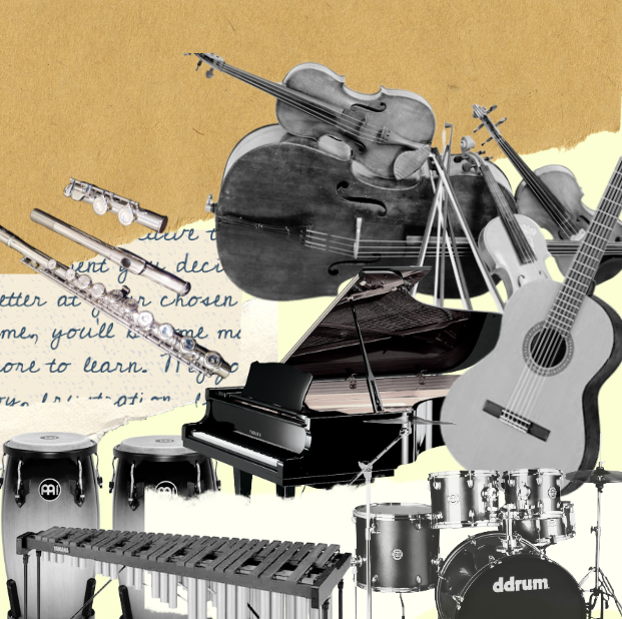
Each of us is probably familiar with certain musical instruments, namely the piano, guitar, drum, or flute. To begin with, musical instruments can be interpreted as devices used to make sounds, usually in making and performing music. There are actually many types of instruments, including keyboard, string, plucked string, woodwind, brass, and percussion. Let’s get a little deeper into each of these categories.
Keyboards are among the most popular instruments. Piano, electric keyboard, organ, and harpsichord are all notable examples. When playing keyboard instruments, you just have to press a certain key and a note is made. Normally, their keyboard will display a series of white and black keys; specifically, there are twelve keys (seven white and five black) in an octave representing the chromatic scale, with the seven white keys representing the C major scale. The range of keys varies, but a common piano would have 88 keys.
Next, we will learn more about stringed instruments - the orchestra’s best friend. stringed instruments include the violin, viola, cello, contrabass, and much more. Musicians play stringed instruments by either using a bow or plucking, altering the pitch by moving their finger placed on the string. You have probably heard of “string quartet” or “string quintet”, right? A string quartet is composed of two violins, a viola, and a cello, while a string quintet has an additional stringed instrument, either another viola, another cello, or a contrabass.
The third family we are looking at is the plucked string. These instruments look and work similarly to the string family; the only difference is that they are not played with a bow (as the family’s name suggests). Some of the well-known members of the plucked string family are the guitar (classical, acoustic, and electric), bass, banjo, ukulele, mandolin, and sitar. Plucked strings can be seen in many genres of music: from the classic Spanish flamingo to modern Rock songs.
I forgot to mention. There is another type of plucked string instrument - the lyre family. Mechanically, they are the same as the ones above; they just have more strings, and each will represent a certain pitch (they are like a mixture of keyboard and plucked string). Some examples of this are harp, lyre, and guzheng.
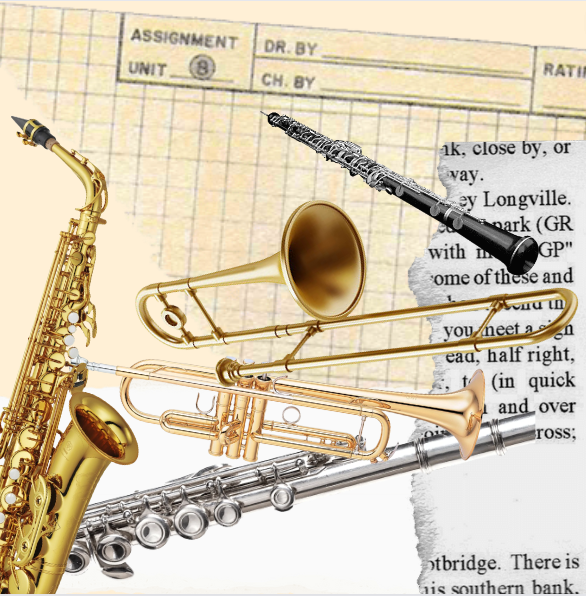
Woodwinds are instruments that require players to create sound by blowing: flute, clarinet, recorder, bassoon, contrabassoon, oboe, and many more. The name of the family incorporates wood - the main material used to make many woodwinds - and wind - the component that helps woodwinds make sound. The pitch can be adjusted by blocking and releasing suitable holes. Woodwinds are popular in orchestral and traditional music.
Brass. Honky tonk. As the name implies, brass instruments are made from brass, - the alloy of copper and zinc. Like woodwind, players have to blow air into it, however, the pitch-adjusting part is unique to each brass instrument. Notable brass instruments are the trumpet, trombone, French horn, and tuba. Most of them were originally used in classical music, then in jazz.
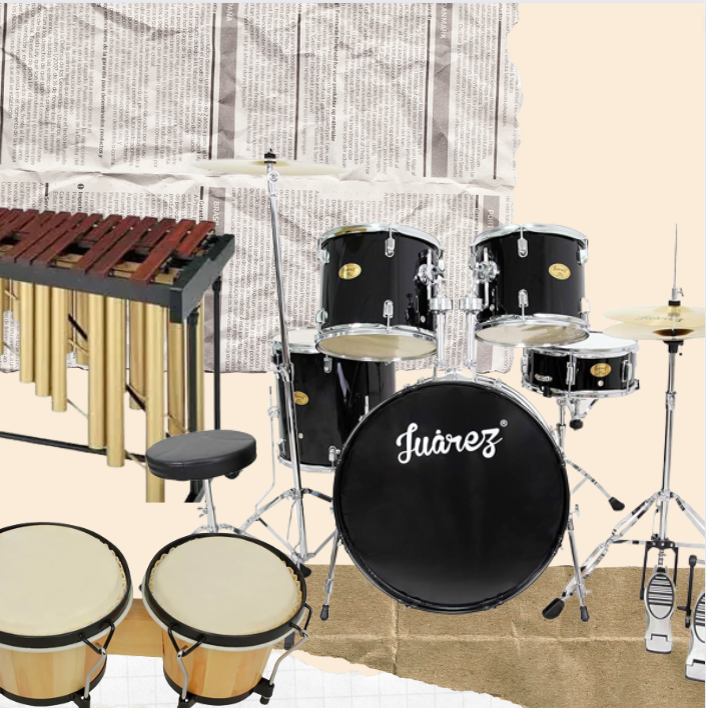
Percussion is a special group. It includes both a pitched instrument - one that you can control the pitch - and an unpitched instrument - one that you cannot). Some popular unpitched instruments can be seen in a typical drum set: kick, snare, hi-hat, crash, cowbell, etc.; some famous others are bongo, congo, and shaker. The representatives of pitched instruments consist of the xylophone, marimba, vibraphone, and steel pan. Percussion instruments are played with a pair or more sticks, hitting different parts of the instrument to make a sound. Unpitched percussions are mostly used to make beats and add-ons, while pitched percussions can be used as any other instrument to create melodies and harmonies.
Hey, you have discovered many of the instruments and their classification. Hopefully, this can help you get a broader look at music and make you a bit more curious. That's it for our trip today, see you next time.